Course description
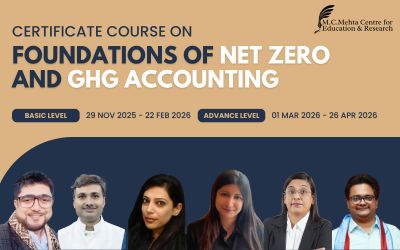
This course on Foundations of Net Zero and GHG Accounting provides a comprehensive grounding in climate action strategies and the technical skills needed to measure, manage, and disclose greenhouse gas (GHG) emissions. It brings together the science of climate change, the evolving policy and market frameworks for Net Zero, and practical tools for GHG accounting.
Designed for professionals, policymakers, researchers, and students, this program blends conceptual understanding.
Part A explores the global movement towards Net Zero, including pathways, finance, policy, challenges, and case studies of governments, corporations, and local bodies.
Part B dives into the methodologies of GHG accounting, covering Scope 1, 2, and 3 emissions, international protocols, and standards.
The Advance Course, equips participants with the skills to translate Net Zero commitments into actionable corporate strategies. It covers identifying emission hotspots, setting baselines, defining targets aligned with science-based targets (SBTi), and drafting roadmaps that prioritise decarbonisation. The program also draws on global case studies to showcase best practices, helping companies integrate sustainability objectives effectively into their strategic planning.
Participants will also learn how to implement decarbonisation strategies across operations and supply chains, integrate Net Zero goals into governance and financial planning, and apply tools such as internal carbon pricing and circular economy models. The course emphasizes monitoring progress through KPIs and reporting via BRSR Core, CDP, and TCFD frameworks, enabling participants to draft a corporate Net Zero Action Plan with verification aligned to ISO 14064, turning sustainability commitments into measurable outcomes.
Through lectures, practical exercises, and case studies, participants will develop the ability to critically analyse Net Zero strategies, assess emissions profiles, and design credible decarbonization roadmaps for organizations and sectors.