Course description

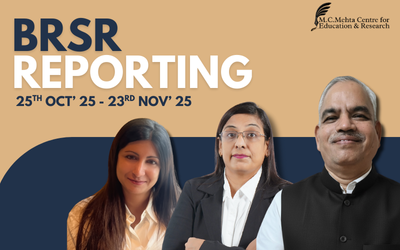
The Certificate Course on BRSR Reporting is a comprehensive 1-month live program (25th October – 23rd November 2025) designed by the M.C. Mehta Centre for Education and Research (MCMCER) in collaboration with All Bits Count. With SEBI mandating BRSR disclosures for India’s top 1,000 listed companies, this course provides participants with the knowledge, frameworks, and tools to navigate the evolving ESG and sustainability reporting landscape.

Through expert-led sessions, real-world case studies, and interactive exercises, participants will:

  • Understand the foundations of BRSR and ESG principles.

  • Learn SEBI’s reporting requirements, including BRSR Core (Annexure I) and BRSR disclosures (Annexure II).

  • Explore global reporting frameworks such as GRI, ISSB, SASB, TCFD, and EU CSRD.

  • Gain practical skills in data collection, disclosure preparation, and ESG risk management.

  • Map BRSR disclosures with UN Sustainable Development Goals (SDGs).

  • Conduct mock disclosure exercises to build reporting confidence.

The program is ideal for sustainability practitioners, ESG analysts, auditors, consultants, compliance professionals, investors, and students aspiring to build a career in ESG and corporate sustainability.

Upon successful completion, participants will receive a Certificate in BRSR Reporting, enhancing their professional credibility and career prospects in the sustainability and ESG domain.

Course Highlights:

  • Live expert-led sessions & interactive group projects

  • Practical toolkits & case studies

  • Career mapping and mentorship support

  • Certificate upon completion

By joining this course, participants will be empowered to drive responsible business practices, enhance compliance, and create long-term sustainable value.

What will i learn?

  • Gain practical knowledge of ESG concepts and SEBI’s BRSR framework (including BRSR Core).
  • Understand the regulatory evolution of BRSR in India and its stakeholder relevance.
  • Analyse the corporate benefits of sustainability reporting, from compliance to investor confidence.
  • Learn to interpret and implement section-wise disclosures under BRSR.
  • Differentiate between mandatory reporting for listed companies and voluntary adoption for others.
  • Build skills to collect, collate, and present ESG data using structured formats.
  • Map BRSR disclosures with UN Sustainable Development Goals (SDGs).
  • Apply learning through mock disclosure exercises and real corporate report analysis.

Requirements

  • This course is open to graduates, postgraduates, and working professionals from any discipline.
  • No prior knowledge of BRSR or ESG reporting is required, as the program begins with the fundamentals.
  • A basic understanding of business, finance, or sustainability concepts is preferred, it is not mandatory.
  • Participants are expected to have access to a laptop or desktop with a stable internet connection to attend the live sessions smoothly.

Frequently asked question

The Business Responsibility and Sustainability Reporting (BRSR) is a type of report comprising non-financial information. The BRSR report contains organizational information on parameters of Environmental, Social and Governance (ESG) and Sustainability aspects. The requirement to prepare this report is specified under Regulation 32(2)(f) of the SEBI (List ing Obligations and Disclosure Requirements) Regulations, 2015. According to the regulation, listed entities ranked among the top 1,000 on the stock exchange based on market capitalization are mandated to include this report as part of their annual report.

Pursuant to SEBI’s circular dated July 12, 2023, a new subset of the BRSR framework, known as BRSR Core, was introduced for assurance by listed entities. This subset includes KPIs under 9 ESG attributes tailored to the Indian and emerging market context. New KPIs such as job creation in small towns, business transparency, and gross wages paid to women were identified. Additionally, to enhance global comparability, intensity ratios based on revenue adjusted for Purchasing Power Parity (PPP) were incorporated.

Yes, however, the applicability is based on a gliding path in the manner given below. The following listed entities mentioned below are required to obtain reasonable assurance on BRSR core: ● By the financial year 2024–25: Top 250 listed entities ● By the financial year 2025–26: Top 500 listed entities ● By the financial year 2026–27: Top 1000 listed entities

NGRBC Principles have explained the term ‘stakeholders’ as individual or group concerned or interested with or impacted by the activities of the businesses and vice-versa, now or in future. Typically, stakeholders of a business include, but are not limited to, its investors/ shareholders, employees (and their families), customers, communities, value chain members and other business partners, regulators, civil society actors, and media.

BRSR requires entities to conduct internal performance reviews against ESG policy and regulatory obligations. The internal assessment can be conducted by an authorised individual, such as the company's Director, a Board committee, or another committee. The report requires that listed entities conduct independent assessments and evaluations of their policies' effectiveness. Reviewing a company's performance against the NGRBC Principles is vital since it identifies areas for improvement. External agencies can conduct assessments to ensure effective review.

Fareed Yaseen

Lectures

19

Quizzes

1

Skill level

Beginner

Expiry period

3 Months

Share this course

Related courses